
The Founding Spirit of the University
and its Educational Philosophy
School Traditions and Characteristics


An Academic Environment with Freedom and Vivacity
In 1994, Ritsumeikan Univer.ity celebrated the 125th
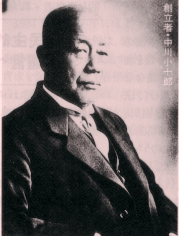
anniversary of the founding of the Saionji's private academy, "Ritsumeikan," in 1869. In 1869, Prince Kinmochi Saionji, Still a young politician, opened the academy in Kyoto. However, the academy was forced to be closed by the pressure of me national government. Later, Mr. Kojuro Nakagawa, former secretary to Saionji, already a leading statesman, asked permission from Saionji to use the name of "Ritsumeikan" for an evening school of law which he opened for the workers and citizens of Kyoto in 1900. Thus with the Prince Saionji's blessings, the school formally adopted the name of Ritsumeikan, along with its spirit.
Prince Saionji used to emphasize the spirit of academic freedom and enterprise. Nakagawa promulgated them as the founding spirit of the school, which became the hallmark of Ritsumeikan University.
After the suppression and sufferings of World War 11, Ritsumeikan University revamped itself into an institution that champions peace and democracy, with due respect to the Constitution of Japan and the Education Fundamental Law. This revitalization of the University was led by Dr. Hiroshi Suekawa, a jurist and steadfast advocate of freedom and democracy. In order to reflect me founding spirit in education and research, Ritsumeikan University has been committed to the following basic principles: up-to-dated and interdisciplinary education and research, collaboration in research, internationalization, networking, and academic contribution to the society.
Policies that Emphasize a Positive Approach to Studies
Ritsumeikan University places special emphasis on education of younger generation. They will play key roles in the orientation and formulation of the world of the 21st Century. The development of their abilities is the most significant task of the university. Through their studies and activities at Ritsumeikan, students learn the requirements of the society and the sense of responsibility, thus giving them opportunities to use their ability for the rest of the world Though the years at Ritsumeikan may be relatively short in their life, students will be able to maximize their opportunities for the future. Following the basic principles of the Education Fundamental Law, the personality of each and every student will be respected and promoted at Ritsumeikan. Ritsumeikan University offers abundant opportunities and facilities to realize these educational goals Ritsumeikan also welcomes students with special abilities and qualifications, since Ritsumeikan believes that students should possess diverse characteristics and talents. Because of these and other features of Ritsumeikan, it has attracted more than 100,000 annual applications for admission in recent years. The applications come from almost every pan of Japan.
Aggressive Research Activities
Research is another pillar of Ritsumeikan University. Both individual professor's research and joint research activities among professors at Ritsumeikan and with other universities and academic institutions have been encouraged. Both disciplinary and interdisciplinary research activities are actively pursued, inviting guest researchers and visiting professors from within Japan and overseas. In 1996, mere are 55 visiting and "chair" professors at Ritsumeikan. The offices of Research Assistance and the Office of Faculty Research Library provide information of public and private grants and funds, preparing meetings, editing professional journals, and doing service for general research activities.
Society, Science and Education for the 21st Century
According to the University's Fourth Long-Term Plan in 1991, new departments of the College of Science and Engineering were established in 1994: Departments of Bio-Science and Technology, Environmental Systems, and Computer Science. The College as a whole already moved to the new campus near the Lake Biwa in Shiga Prefecture, now known as the Biwako Kusatsu Campus (BKC). The new campus is approximately 60 hectares.
In 1996, two additional departments of the College of Science and Engineering were opened: Department of Optical Engineering and Department of Robotics.
In Kyoto campus in 1994, a new College of Policy Science started its education and research. The primary goal of the College is to educate students in the areas of policy and planning.
The Fourth Plan has completely restructured Ritsumeikan's six other Colleges of Law, Economics, Business Administration, Social Sciences, International Relations, and Letters. New programs, for instance, include Concentration Courses in accordance with career opportunities, Sub-Major Course Selections, and, most importantly, Two Semester System of education. In addition to the above new programs for regular students, a life-long-education program for adult students was
introduced for workers and citizens generally.
Agreements were made with several junior colleges by which graduate of the junior colleges can be transferred to the third year undergraduate at Ritsumeikan.
International programs and networking are another feature of the Plan. A Dual Degree Program, for instance, with the American University in Washington, D.C., began in 1992 for two master's degrees and in 1994 for two undergraduate degrees. The program is the first of its kind anywhere in the world. For details, see page 14 et seq.
Finally, research opportunities for graduate students were enhanced and promoted at the Graduate Schools. Full time assistantship was introduced for doctoral students. Availability of scholarship and facilities for study were improved.
Fifth Long-Term Plan
In 1996, the University's Fifth Long-Term Plan was launched with various new programs and projects. The Plan accelerate educational reforms in social science and humanities, in addition to science and engineering. The most important plan will be the opening of the Ritsumeikan Asia-Pacific University (tentative name) in 1999. In Kyoto and Shiga, also, the graduate schools will be strengthened, educational reform will be promoted with a view to best utilize the facilities in Kinugasa and Biwako Kusatsu Campuses. A lifelong education will be furthered in each College.
Through these steps, Ritsumeikan University is determined to improve its development of human resources which can take a more active role in the 21st Century. The University is going to fulfill its responsibilities as a higher educational institution, and will exert itself for the advancement of research and
education both in Japan and throughout the world.
Democratic Administration of the University
Based on the idea of autonomy for all constituent member of the University, important matters related to the administration, education and research are decided through the exchange of opinions at each Faculty Meeting and at the University Council. The Council consists of Board of Trustees, Faculty-Staff Labor
Union, Graduate and Undergraduate Student Councils as its full member, and Board of the Cooperative Association as observer. Student participation in decision-making at the Council and in the election of the president of the University is guaranteed. Through these activities, Ritsumeikan students are able to positively involve themselves in the activities of the University.
Ritsumeikan University places special emphasis on long-term planning, trying to realize its educational goals in the optimum way within a stringent budgetary limit.
Copyright© 1996
Integrated Information Center
Ritsumeikan
All rights reserved.