To fabricate 3-D microstructures, photoforming is applied. However, the
presently proposed photoforming apparatus is large and requires a special
laser beam (ultra-short-pulsed near-infrared Ti:sapphire) or special resin (two-photon-absorbed urethane material) We developed a
desktop micro-photoforming apparatus using a DVD optical head and a visible
light-curable resin (DF-200N, Nippon Kayaku Corp.), both of which are commercially
available . Since the microstructure is generated by scanning a focused
laser beam to solidify the contour of a liquid photopolymer, the resolution
is determined by the laser beam intensity distribution and the absorption
of light within the polymer. To decrease the solidified depth, a thin resin
film was made using a spinner, as shown in Fig. 1
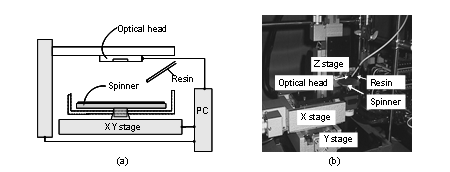
Fig. 1. Schematic diagram (a), and
photograph (b) of the spinner-type micro-photoforming apparatus
Figure 2 shows the shuttlecock optical rotor with a 30 mm diameter and 15 mm thickness. The fabrication conditions were a scan speed of 25 mm/s, scan pitch of 0.3 mm, single scan and a laser power of 0.35 mW. The overall time was 12 minutes to fabricate 16 rotors.
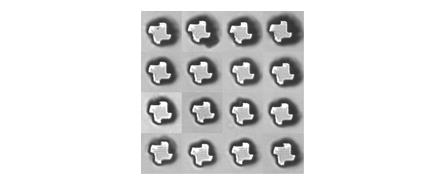
Fig.2. Shuttlecock optical rotors, 30 mm diameter and
15 mm
thick, fabricated by photoforming
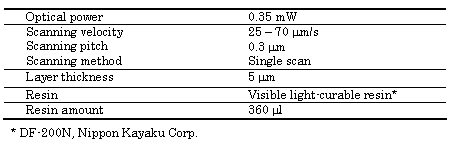
Table 1. Photoforming
conditions for the slope of the rotor
Complicated 3-D microstructures were fabricated by stacking thin resin layers that had been solidified into the cross-sectional shape using a DVD LD with the wavelength of 650 nm. Table 1 shows the photoforming conditions for the slope of the rotor. Figure 3 shows the 3-D design (upper), cross sections (middle) and fabricated layers (lower) of 5 mm thick each. It is found that the fabricated layer shapes are similar to those of the corresponding cross sections.
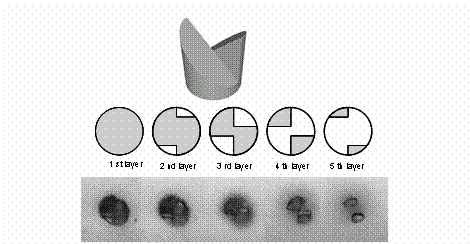
Fig.3. Microstructures with slopes are fabricated by stacking of thin resin layers having the 2-D cross-sectional shape, upper: 3-D designed shape, middle: 2-D cross sections designed, and lower: fabricated 2-D cross-sectional-shape layers of 5 mm thick each