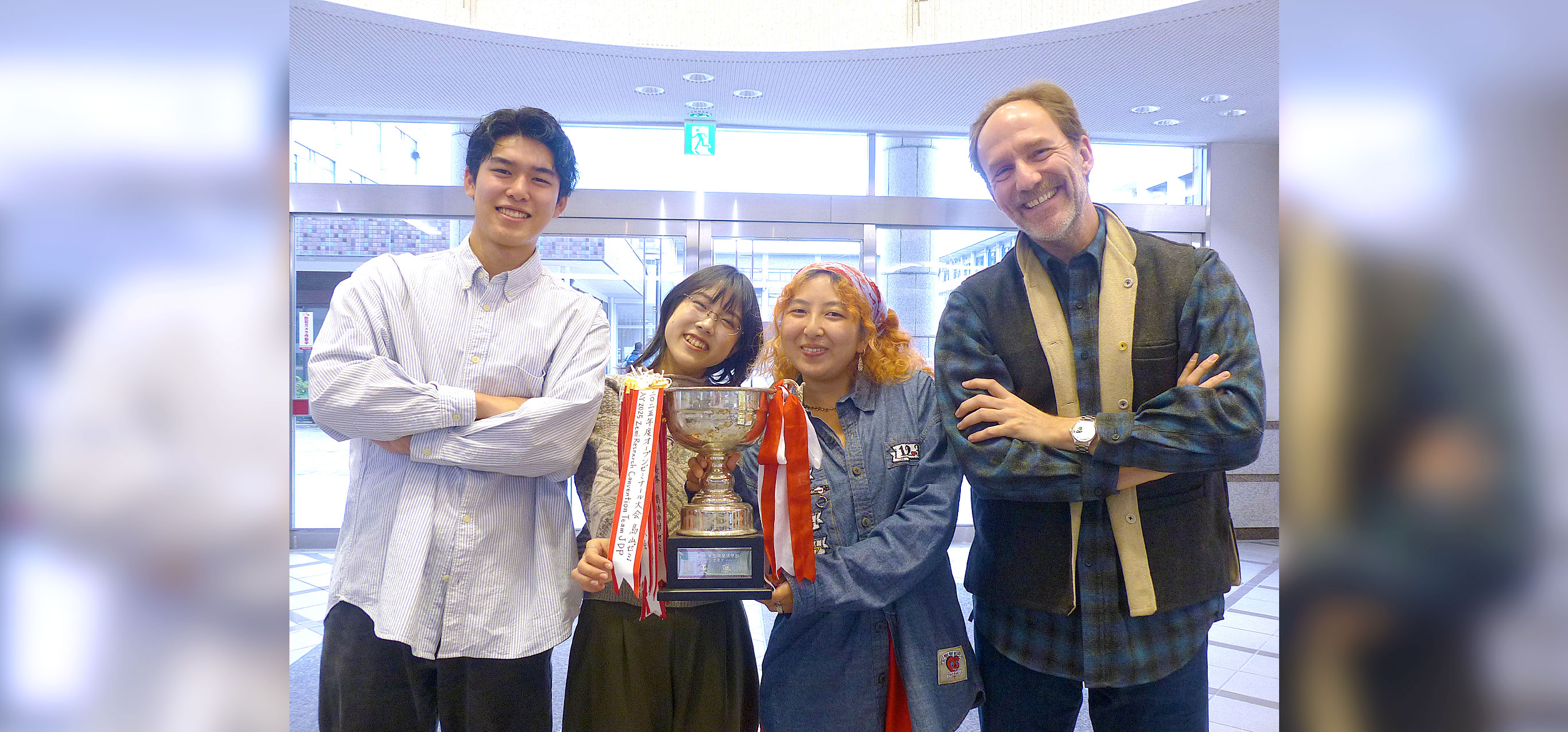
Zemi Research Convention 2025 “Where do we find the laughter?”
JDP Team (Team name: The Japarican: Trans-Pacific Humor Accord)
Keika Kurokawa, Monet Kogure, Itsuku Shinya
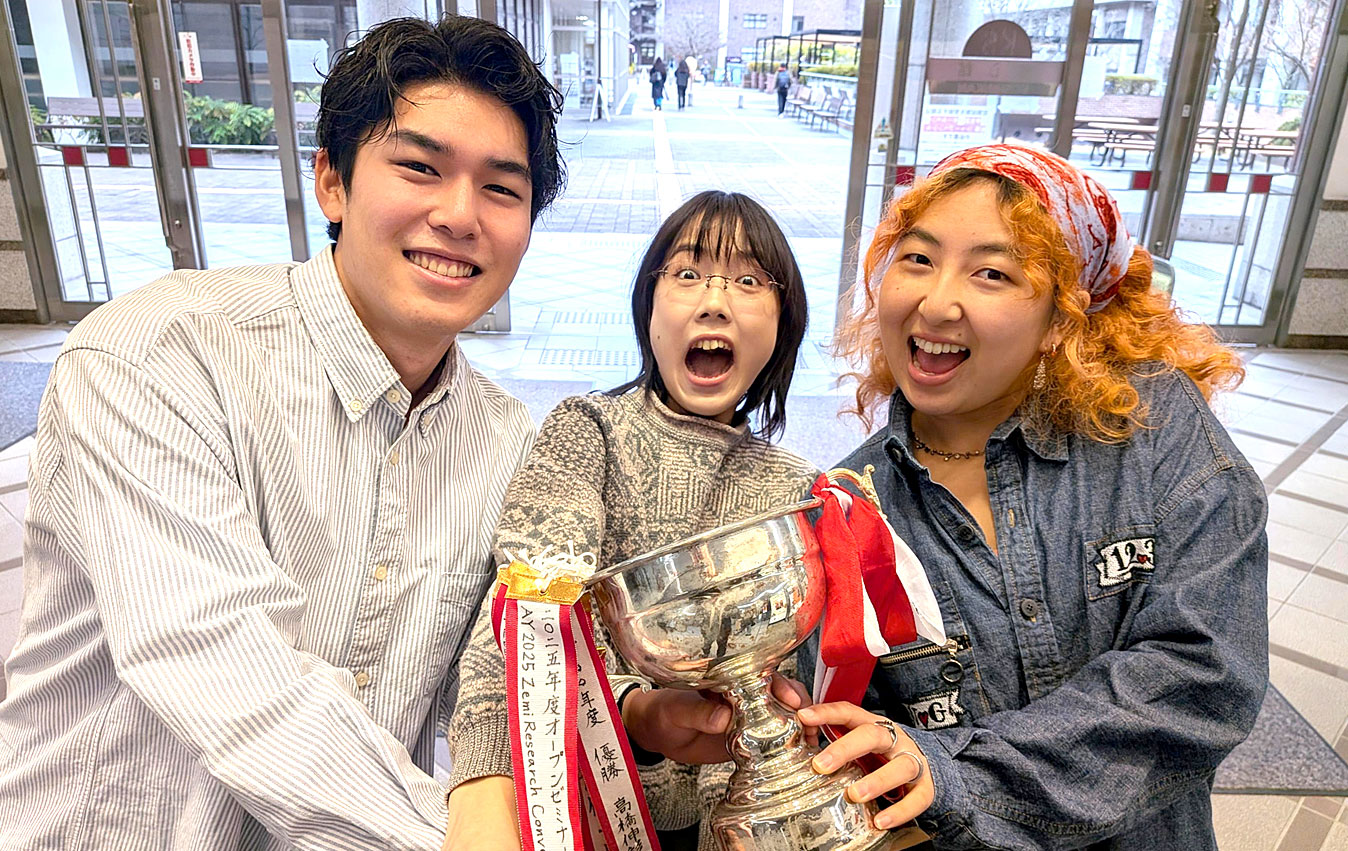
We interviewed JDP students who presented “Where do we find the laughter?” at the Zemi Research Convention 2025.
Please give details of your Zemi Research Convention presentation.
Our group presented a comparative cultural analysis of Japanese Manzai and American Stand-up comedy, focusing on the concept of “laughter,” which we highlighted in our team name. By examining performance styles, social roles, and the functions of humor, we identified a key shared mechanism: laughter operates as a psychological response of pleasure produced through the temporary release of repression.
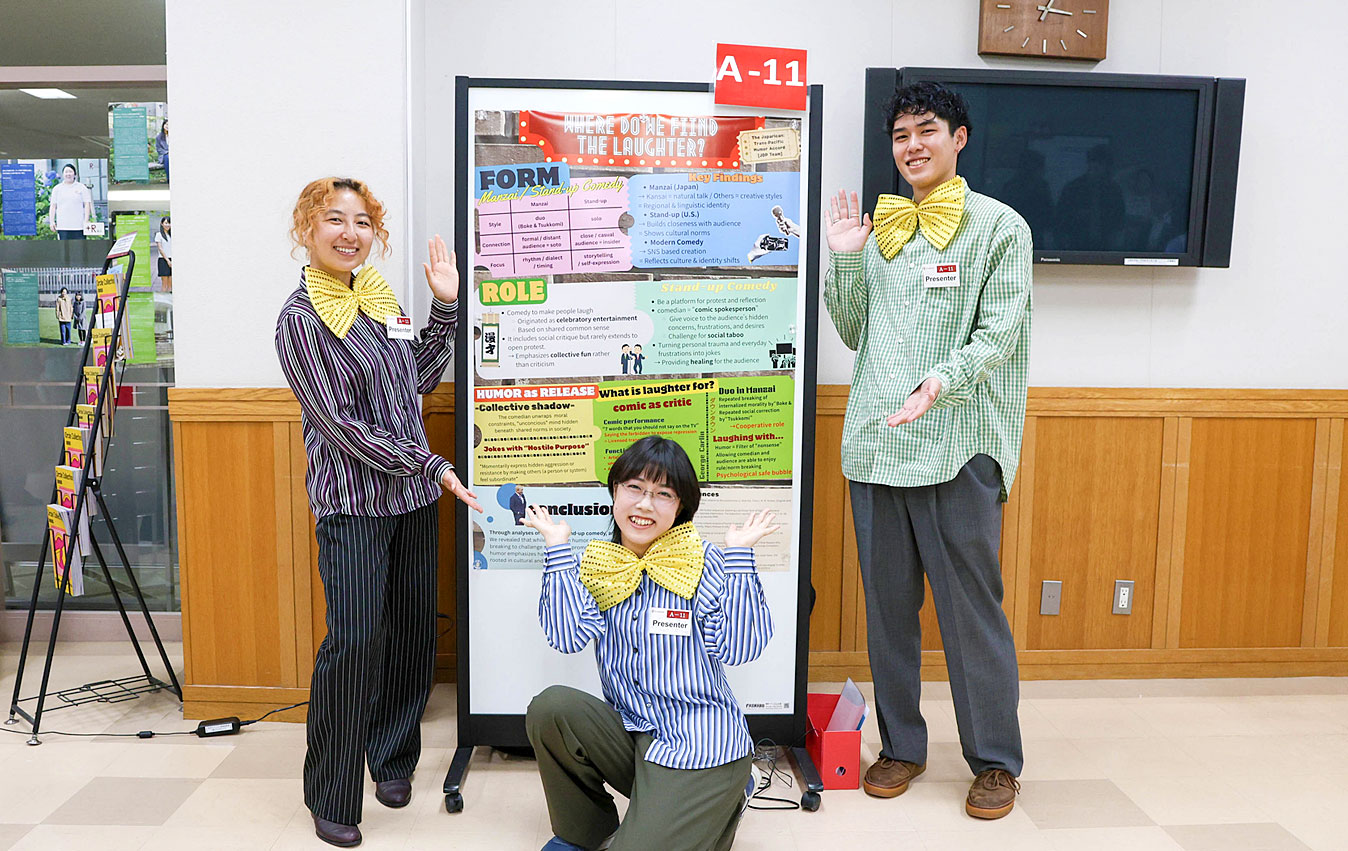
In Manzai, humor emerges from the cooperative dynamic between the boke, who disrupts social rules and expectations, and the tsukkomi, who restores social or moral order. This interaction creates a psychologically safe space in which audiences can collectively experience norm-breaking without threatening social stability. As a result, Manzai reflects the emphasis on balance, shared morality, and interpersonal harmony that characterizes Japanese collective culture. In contrast, American Stand-up comedy positions the comedian as a “comic spokesperson” who openly exposes social repression. Stand-up performers frequently address topics such as race, religion, gender, and politics, subjects often avoided in Manzai due to their social sensitivity. Rather than preserving harmony, Stand-up comedy uses linguistic rebellion and boundary-pushing to challenge dominant norms and provoke critical reflection.
This comparison demonstrates how humor functions differently depending on cultural context. While Manzai prioritizes collective cohesion through controlled norm violation, American Stand-up comedy embraces confrontation as a form of social critique. In both cases, however, comedians play a crucial role in giving voice to thoughts and tensions that are normally suppressed beneath social rules and expectations. In this sense, humor serves as a medium through which what Freud (1963) describes as the “collective unconscious,” or repressed social desires, can be momentarily revealed and shared through laughter.
Why did you choose the theme?
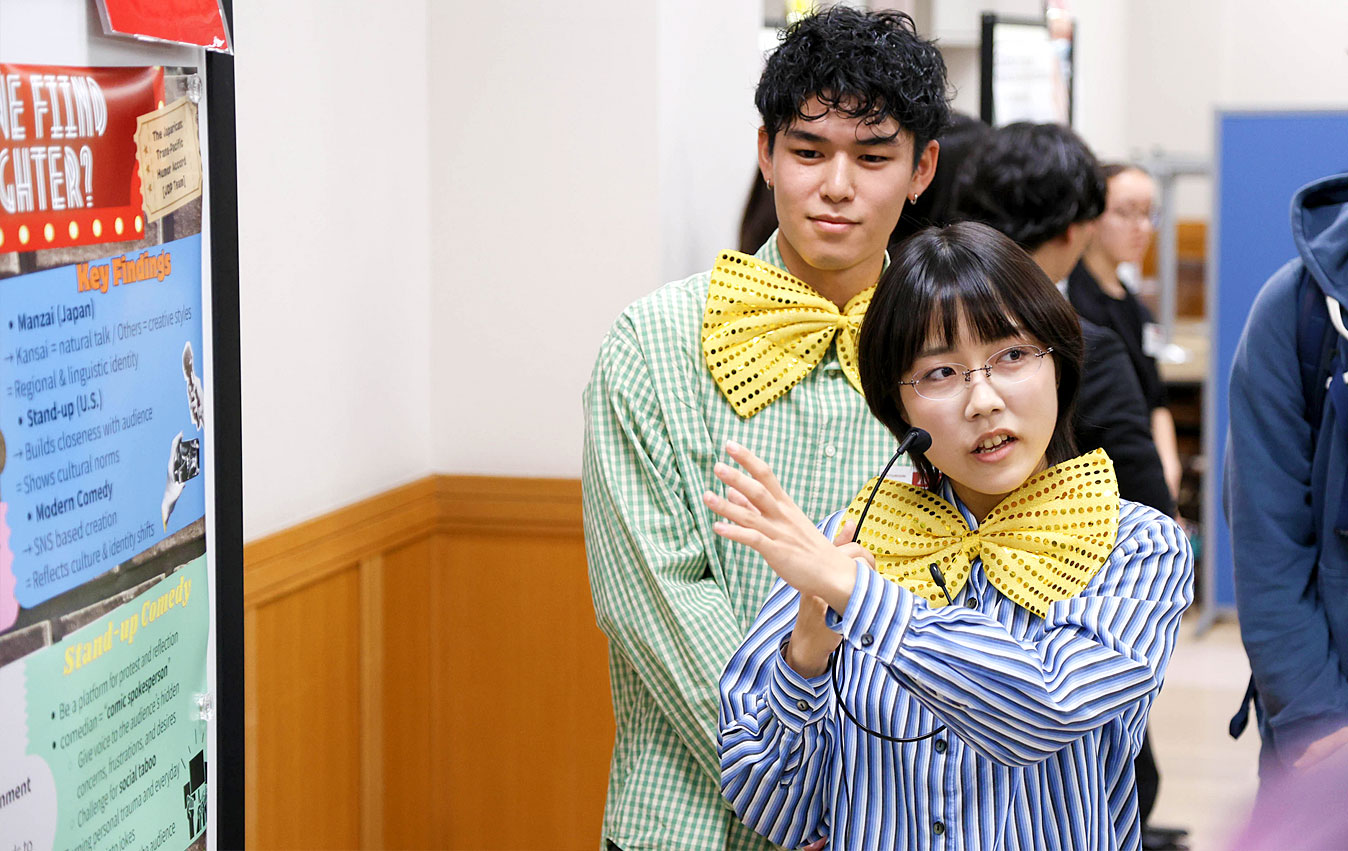
We chose this theme due to our experiences at American University (AU) and Ritsumeikan University (RU). After moving back from the 2 years of studying at AU, and when we were thinking of the theme to choose, we all agreed on selecting the theme of differences between Japanese culture and American culture, based on what we experienced. While we were brainstorming from that, we all agreed that the culture of comedy or the things people laughed at were different by listening to the daily conversations, TV shows, and SNS in both countries. So, from that point of view, we then again brainstormed and decided to focus on the Manzai (Japan) and Stand-up comedy (U.S.), which are very representative comedy styles in Japan and the U.S.
How did you apply what you learned during your two years at American University?
We applied the lessons and insights from daily conversations and interactions with friends, colleagues, teammates, professors, and others. We felt like people in the U.S., including international students, often use taboos, sarcasm, and other ways to make fun of others. These ways are not common in Japan and are completely different from Japanese culture. Japanese comedy, Manzai, is mostly for enjoyment, and it is becoming less common to make fun of people based on appearance, gender, or disability, as this has become taboo in recent years due to audience criticism on SNS. The differences in how to make fun of people, how to perceive taboos, and the differences in comedy we experienced at American University were very interesting to us, and we decided to focus on the differences in comedy.
What questions and comments did you receive at the Zemi Research Convention, and which made the most impact on your group?
We received a question about the implications of the expanded use of social media platforms in comedy. This question was particularly eye-opening for our research, as it drew attention to how digital platforms diversify performance styles while simultaneously increasing accessibility to comedy. It also prompted us to consider how social media reshapes the relationship between performers and audiences, shifting humor from a localized, culturally bounded practice to one exposed to global audiences.
What kind of things did you experience as a group leading up to the convention?
Luckily, since we experienced lots of group work while we were in AU, there were not many difficulties processing while we were leading up to the convention. To look back on why we did well, the reason behind that is that we divided the group work equally, and we checked the progress once a week with a group call. Although the difficulties we faced were the difficulties in explaining the undefined specific Japanese words that are used in Manzai to English, or the explanations we could explain in Japanese, which were difficult to translate into English. But we overcame these difficulties by discussing with group members, and most importantly, Professor Smith (our zemi professor) had 100% supported us in interpreting these difficult terms while we were in the class working on the discussion, posters, and rehearsals.
Message to the next year's participants.
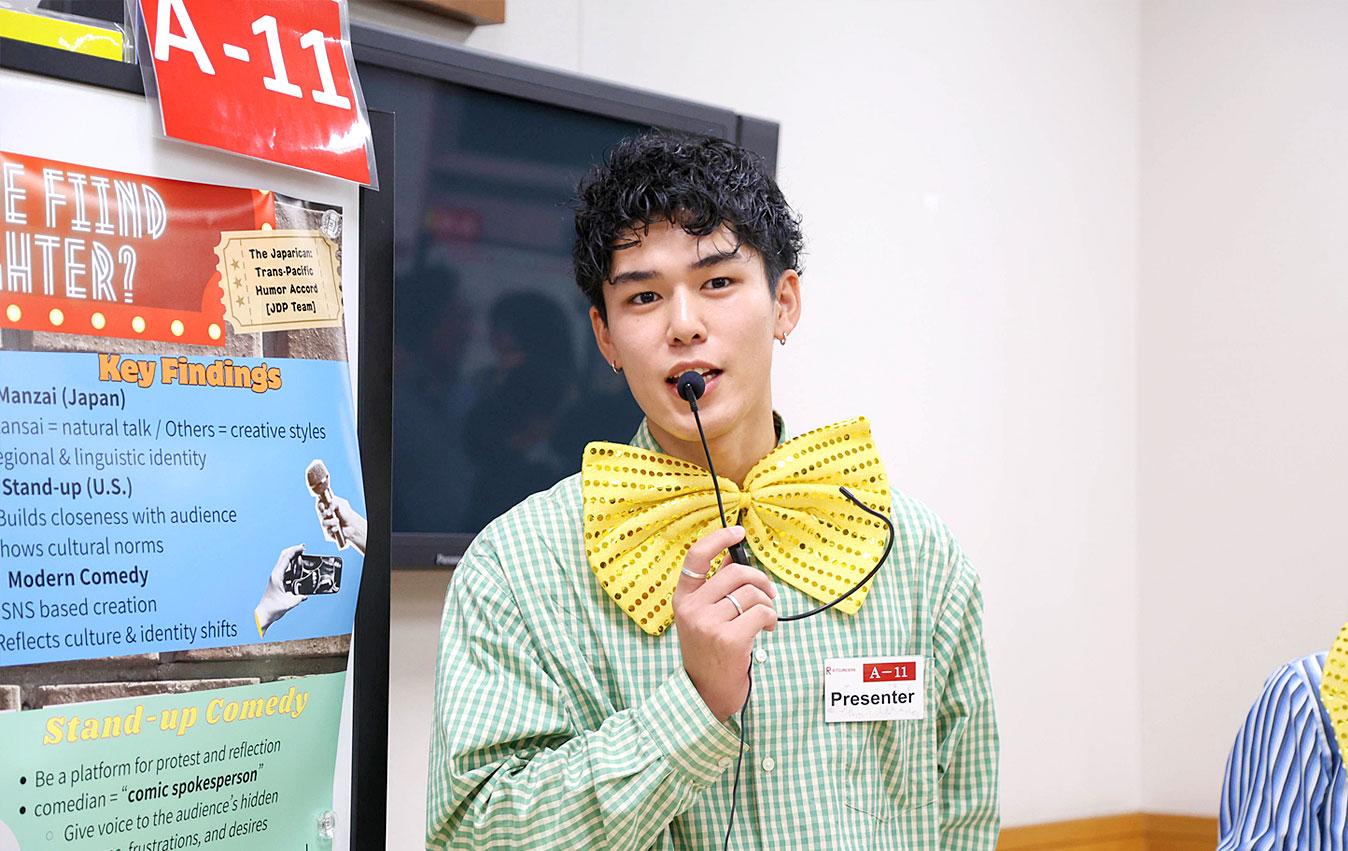
For the next year’s participants, we’ve got some advice that can make your presentation more fun and better. Having personal curiosity for the topic makes the research process and preparation more enjoyable. It is sometimes difficult to find a topic that matches all members’ interests, but keep trying to find the interesting points that enable you to make the presentation more interesting. When it comes to the presentation itself, try to use the visual media such as images, short videos, or interactive activities like quizzes or skits. It is important to keep getting the attention of the audience. It is quite challenging for many groups to maintain audience attention and focus in a crowded, freely moving, and relatively loud environment. Also, since the poster alone has limited information, using visual information beyond posters and incorporating interactive elements like quizzes to engage the audience is important to help them more easily imagine and understand. Lastly, collaborating with teammates and enjoying the presentation and its process is important. Presenting in front of many people will be a valuable experience for many participants, and we could have an accomplishment after the presentation, so we strongly feel it is worth participating. So just have fun with it!
February 2026
MORE INTERVIEWS
-
Finding Confidence Across Borders: A JDP Fifth-Cohort Student Reflects on Four Years of Growth in Japan and the United States
HIROSE Alex Aoi
Fourth-year Joint Degree Program (RU-home)2026.3.16
studentlife|academics|jdp|
-
From Language Learning to Peacebuilding: Growing Through Global Engagement
PHAM Nhat Linh
Second-year Global Studies Major2026.3.9
studentlife|academics|gs_major|
-
International collaboration is not merely an ideal, but something that is both achievable and essential
Tran Duc Tuan (Steven)
Honda (Graduate School of International Relations Alumnus 2015)2026.2.13
alumni|
-
Zemi Research Convention 2025 “Where do we find the laughter?”
JDP Team
(Team name: The Japarican: Trans-Pacific Humor Accord)2026.2.3
academics|jdp|openseminar|
-
Diversifying opportunities and improving oneself by crossing borders
Jameel Mikaheel Yamaguchi
Fourth-year Global Studies Major2026.1.26
studyabroad|international|gs_major|
-
I participated in the Peace Studies Seminar and engaged in meaningful discussions with peers who shared a commitment to deepening our understanding of peacebuilding and broadening our perspectives.
ONG Kristen Valeria
Second-year Global Studies Major / International Student from Singapore2025.11.5
studentlife|academics|gs_major|