Research Areas 研究内容
Information Protection Technology 情報保護技術
Keywords: Secure Computation, Multiparty Computation, MPC, Secret Sharing キーワード:秘密計算,秘密分散
In recent years, with the advancement of big data and the Internet of Things (IoT), the collection and utilization of large amounts of data have enabled solutions to various social issues and the development of high-value services. However, because the collected data often contains personal information, there is a constant risk of information leakage. With legal frameworks such as the EU's GDPR and Japan's Amended Act on the Protection of Personal Information, there is a growing demand for technologies that provide a balance between information protection and utilization. While conventional encryption methods allow for data encryption and decryption processes, they face the challenge that the encrypted data must be restored (decrypted) to its original state (plaintext) before it can be processed or analyzed.
近年,ビッグデータやモノのインターネット(IoT)の進歩に伴い,大量のデータを収集・活用することで,様々な社会課題の解決や新たな価値を持つサービスの開発が可能になっています.一方で,収集したデータには個人情報が含まれるため情報漏洩のリスクがあり,EUのGDPRや日本の改正個人情報保護法などの法整備により,「情報の保護と活用の両立」を可能にする技術が求められています.しかし,従来の暗号技術は情報の暗号化と復号ができる一方で,暗号化したデータを活用する際には,一度元の状態に復元(復号)しなければならないという課題があります.
Our laboratory focuses on realizing Secure Computation (also known as Multiparty Computation, MPC), which expands upon traditional encryption to allow various statistical operations to be performed while keeping the data in its encrypted state. For example, Figure 1 shows an example of computing average annual income using secure computation, which is useful in application such as finding wage gap while keeping the actual salary information private. Specifically, we focus on the Threshold Secret Sharing approach to develop methods that realize any operations, from simple average calculations to complex AI-driven data processing, efficiently, cost-effectively, and securely.
当研究室では,従来の暗号技術をさらに発展させ,データを暗号化して保護したまま様々な処理を行える「秘密計算」に注目しています.例えば,図1に秘密計算を用いて平均年収を求める例を示しています.具体的には,この「秘密分散」という技術を研究し,図1に示すような単純な平均値の算出からAIによるデータ処理に至るまで,多様な演算を効率的かつ安価・安全に実現する手法を研究しています.
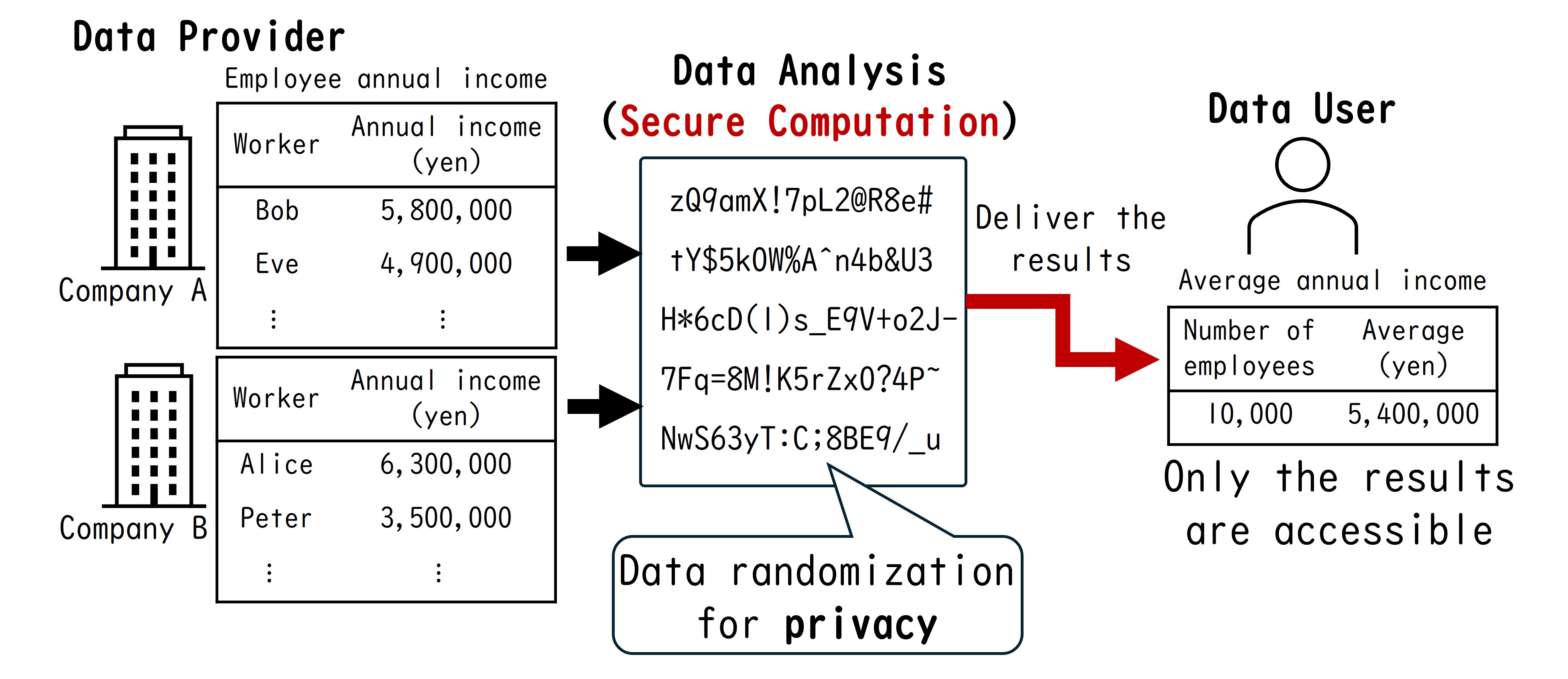
Figure 1: Example of calculating average annual income using secure computation 図1:秘密計算を用いて平均年収を求める例
For detailed explanatory articles regarding secure computation, please refer to our publications page.
秘密計算に関する詳しい解説記事については,こちらの研究業績ページをご参照ください.
Cryptographic Application Technology 暗号応用技術
Keywords: Secure Search, Searchable Encryption キーワード:秘匿検索,検索可能暗号
Cloud-based data storage and sharing offer significant advantages, including location-independent access, data utilization by authorized multiple users, and reduced infrastructure costs. By storing their information in cloud storage, users can access their data anytime and from anywhere. However, when using such service in public clouds, data must be encrypted to protect sensitive information. Conventional encryption technology faces the challenge that data cannot be searched without being decrypted.
クラウドを用いたデータの保存・共有には,場所を問わないアクセス,許可された複数人でのデータ活用,インフラの設置コスト削減といった大きなメリットがあります.つまり,ユーザは自分の情報をクラウドストレージに保存することにより,いつでも,どこからでも自分のデータをアクセスできます.しかし,このような,誰でも利用できるパブリッククラウドを利用する際,機密情報を保護するためにはデータを暗号化して保管する必要がありますが,従来の暗号技術では,復号(暗号化の解除)をせずにデータを検索することができないという課題があります.
Therefore, our laboratory conducts research on Secure Search technology (also called as Searchable Encryption), which enables the efficient retrieval of necessary information from cloud-stored data without restoring the encrypted data to its original plaintext state. Moreover, in addition to standard keyword-based searches, we focus on achieving lightweight search processing and developing efficient, wide-ranging search methods that enable direct searching of data beyond pre-defined keywords.
そこで当研究室では,暗号化した状態の情報を復元することなく,クラウド上のデータから必要な情報を含むデータを効率的に取り出せる「秘匿検索技術(検索可能暗号)」の研究を行っています.さらに,従来のキーワードを用いた検索だけでなく,軽量な検索処理の実現に注目し,事前に決めた特定のキーワード以外でも直接検索が可能な,効率的かつ広範囲な検索手法を研究しています.
Technology for Realizing Zero Trust ゼロトラストの実現に必要な技術
Keywords: Secure Communication, User Authentication, Zero-Knowledge Proofs, Digital Signatures, Blockchain キーワード:暗号通信,ユーザ認証,ゼロ知識証明,電子署名,ブロックチェーン
In today's world, where promoting Digital Transformation (DX) through the use of cloud and AI services is essential, the Zero Trust concept (Shore, 2021) has become crucial. Based on the challenges of traditional boundary defense, it treats all communication accessing information assets as untrusted and verifies them accordingly.
クラウドやAIサービスの活用によるDX(デジタルトランスフォーメーション)推進が不可欠な現代においては,従来の境界防御型の課題を踏まえ,情報資産にアクセスするすべての通信を「信頼できないもの」とみなして検証する「ゼロトラスト」の考え方(井本, 2023)が重要になっています.
Aiming to realize this concept, our laboratory researches necessary technologies, such as secure communication, user authentication, and zero-knowledge proofs, achieving enhanced security by combining secret sharing with cryptographic techniques. Additionally, we are researching solutions to ensure data validity and reliability by leveraging the transparency provided by blockchain technology.
当研究室ではこの概念の実現を含めて,安全なシステム構築を実現するために,秘密分散と暗号技術を組み合わせることで,より強い安全性を持つユーザ認証やゼロ知識証明などを研究しています.また,ブロックチェーン技術が提供する透明性を活用し,データの正当性や信頼性を保証できるソリューションの研究も行っています.
References:
参考文献:
- M. Shore, S. Zeadally and A. Keshariya, "Zero Trust: The What, How, Why, and When," in Computer, vol. 54, no. 11, pp. 26-35, Nov. 2021, doi: 10.1109/MC.2021.3090018.
- 井本 直樹, "境界防御とゼロトラスト概説," 情報の科学と技術, 73 巻, 3 号, pp. 87-94, 2023. doi: 10.18919/jkg.73.3_87.
Cryptography in the Post-Quantum Era ポスト量子時代における暗号
Keywords: Information-Theoretic Security, Distributed Post-Quantum Cryptography/Signatures, Quantum Cryptography キーワード:情報理論的安全性,分散型耐量子計算機暗号・署名,量子暗号
Currently, widely used encryption technologies such as AES, RSA, and elliptic curve cryptography focus on computational security, which relies on the mathematical difficulty of solving prime factorization and discrete logarithm problems. This implies that the computational cost required to break these ciphers with traditional computers is enormous, making them practically unbreakable. However, with the advancement of quantum computers possessing higher processing power, these cryptographic technologies could be easily broken. Therefore, research and transition to post-quantum cryptography, which is secure against quantum computers, are being conducted worldwide.
現在広く利用されているAES,RSA,楕円曲線暗号などの技術は,「素因数分解」や「離散対数問題」を解くことの数学的困難さに依存した計算量的安全性に注目しています.これは,従来の計算機(コンピュータ)では解読に必要な計算量が膨大になり,実質的に解読不可能であるという考え方です.しかし,従来よりも圧倒的に高い処理能力を持つ量子計算機が実用化されると,これらの暗号技術は容易に解読されてしまうため,世界中で量子計算機に対しても安全な耐量子計算機暗号への移行と研究が進められています.
Our laboratory conducts research on improving and applying existing post-quantum cryptographic technologies. Additionally, we are exploring cryptographic technologies that achieve stronger security by introducing information-theoretically secure information distribution and protection methods, such as secret sharing, and their possible applications.
当研究室では,既存の耐量子計算機暗号技術の改善・応用の研究に加え,秘密分散など,情報理論的安全性を持つ情報分散・保護技術を導入することで,さらに強い安全性を実現する暗号技術とその応用に関する研究を行っています.
[Future Research Directions]
【補足:今後の研究展開について】
As a future development, our laboratory is also advancing research on quantum cryptography based on quantum theory. In addition to realizing cryptography that remains secure even with the use of quantum computers, we plan to research applications of quantum cryptographic technology and new cryptographic technologies through hybrid configurations that combine them with conventional cryptographic methods.
今後の展開として,当研究室では量子理論を用いた「量子暗号」に関する研究も進めています.量子計算機が登場しても安全な暗号の追求に加え,量子理論を使った暗号技術,その応用や,従来の暗号技術と組み合わせた「ハイブリッド構成」による新たな暗号技術の研究も行う予定です.
AI + Cybersecurity AI+サイバーセキュリティ
Keywords: Adversarial Attacks, Large Language Models (LLM), Vulnerability Detection, Penetration Testing キーワード:敵対的攻撃,大規模言語モデル(LLM),脆弱性検知,ペネトレーションテスト
Artificial Intelligence (AI) is utilized in various applications, such as voice assistants, AI-powered robots in manufacturing, and autonomous driving technology. Conversely, adversarial attacks designed to intentionally mislead AI and machine learning models have become a significant threat. A prime example is an attack on image recognition AI used in autonomous driving, where subtle differences are added to input images to trigger misclassifications.
AI(人工知能)は,音声アシスタントや製造業のAI搭載型ロボット,自動運転技術など,様々なシーンで活用されています.それに伴って,AIや機械学習モデルを意図的に誤判断させる敵対的攻撃の研究も盛んに行わています.例えば,自動運転で用いられる画像認識AIに対して,入力画像に微小な変化を加え,AIに誤分類を引き起こさせる攻撃などがその一例です.
Our laboratory analyzes the characteristics of these AI/Machine Learning (ML) models and investigates attack strategies that exploit system vulnerabilities. We focus on the research through the following two approaches:
当研究室では,これらのAI・機械学習(ML)モデルの特徴を分析し,システムの弱点を狙う攻撃戦略を検討した上で,以下の2つのアプローチから研究を進めています.
- Investigation of defense mechanisms to prevent such attacks.
- それらの攻撃を防ぐ防御手法の検討
- Leveraging model weaknesses as beneficial features for model protection and identification.
- モデルが持つ弱点を利用し,モデルの保護や識別などの有用な性質として利活用
Additionally, the recent evolution and scaling of deep learning technology have led to advancement in model accuracy for tasks such as natural language processing. With the advancement of Large Language Models (LLMs) trained on massive datasets, AI can now handle increasingly complex tasks. Our lab applies LLM technology to the cybersecurity domain (e.g., Static Application Security Testing (SAST), penetration testing, and vulnerability detection) to advance and automate conventional security processes.
また近年,ディープラーニング技術の発展と大規模化により,自然言語処理などのタスクにおけるモデルの精度が飛躍的に向上しました.特に膨大なデータで学習された大規模言語モデル(LLM)の登場により,AIがより複雑なタスクをこなせるようになり,その有用性が広く認知されています.当研究室では,このようなLLM技術をサイバーセキュリティ分野(例えば,SAST:静的アプリケーションセキュリティテスト,ペネトレーションテスト,脆弱性検知など)へ適用し,従来のセキュリティプロセスの高度化・自動化を実現する研究を行っています.