5. Career Development Support to Foster Independent Career Choices
In recent years, the range of information and opportunities available to students has expanded significantly due to earlier recruitment cycles, an increase in internships, and the expansion of job-hunting support services both on and off campus. On the other hand, with so many options available, it is not uncommon for students to feel unsure of where to start or anxious about moving forward on their own. In light of these circumstances, Ritsumeikan University has been reviewing its support systems to ensure that students can choose the support that best suits their needs and use it as a stepping stone to their next course of action.
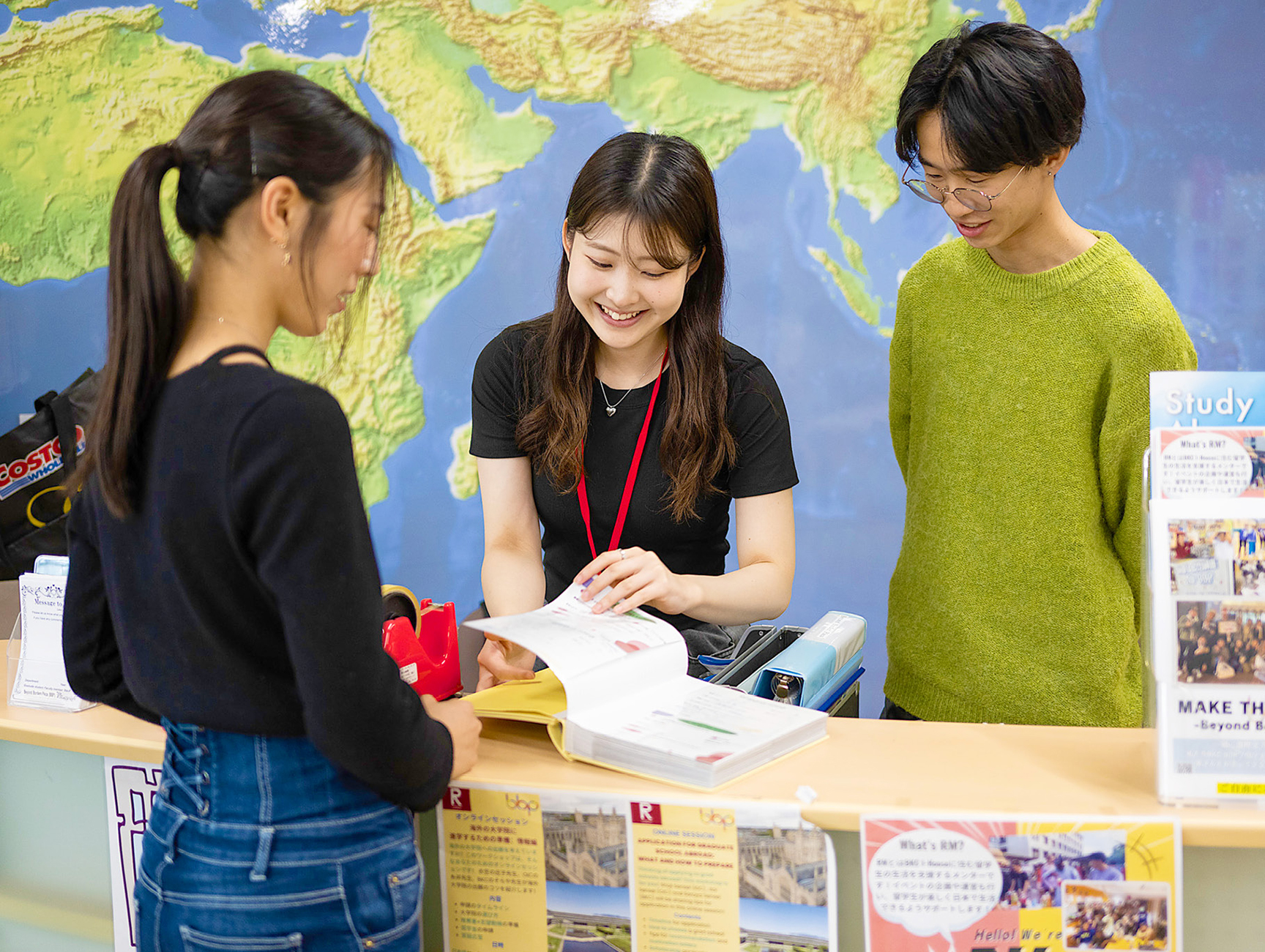
Specifically, since the COVID-19 pandemic, we have been offering a range of services, including career and job placement guidance, company information sessions, mock interviews, and assistance with application forms, based on a hybrid model that combines in-person and online formats. We have also established a system to monitor the progress of each student through regular check-ins via phone or other means, ensuring they receive the necessary support. During general orientation sessions, we present an overview of the job-hunting process, and through subsequent individual consultations and video content, we support students in identifying the preparations they need and taking the next steps.
For students who are anxious about their job search or whose efforts are not going as planned, we have been assessing their situations early on and providing individual counseling as well as connecting them with relevant organizations both on and off campus. We have also provided opportunities for students to consider their career paths from the early stages of their university studies, and through classes and guidance sessions, we have shown them how to engage with society and the wide range of career options available. We also provide tailored support to international students, graduate students, and students with special needs, utilizing a system where alumni and students who have received job offers support their younger peers to provide a wider range of opportunities for receiving advice based on real-world experience.
In recent years, as students’ needs have become increasingly diverse and individualized, we have streamlined our lineup of support services and established an environment that makes it easier for students to access the information and support they need through the “Job Hunting Guide Portal.” We are also stepping up our support for the actual selection process, including interviews and application forms.
We have also expanded our support services for students aiming for highly competitive fields such as the national civil service general career track, the Certified Public Accountant exam, and the bar exam, ensuring they can effectively prepare for their goals by keeping a close eye on changes in examination systems and hiring trends. This has produced steady results, including 84 students passing the final round of the AY 2024 national civil service general career track spring exam, placing us third nationwide, and 55 students passing the Certified Public Accountant exam in 2025, placing us sixth nationwide.
Through these initiatives, we have created an environment where students can make well-informed career choices by taking advantage of guidance and individual counseling tailored to their specific circumstances. As a result, the university has maintained a job placement rate of over 95%. Career development support has been provided not only to assist students in deciding where to work, but also to help them develop the ability to think about their future, make choices, and take action on their own.
Contents
-
Chapter Ⅰ
Significance and Positioning of the AY 2026 Plenary Council
To consider the future direction of Ritsumeikan University
- 1. Changes in the social and higher education environment surrounding universities
- 2. What changes in the social and university environment have asked about undergraduate and graduate student learning
- 3. The types of undergraduate and graduate students Ritsumeikan seeks to produce in light of changes in the social and university environment
- 4. As we enter the second half of R2030
- 5. The Role of the AY 2026 Plenary Council
- 6. List of key themes and annual schedule for AY 2026
-
Chapter ⅡThe Plenary Council as a Process of Academy Co-creation
—Building on Discussions Since AY 2022—
- 1. Progress Made in Academy Co-creation and the Expanding Dialogue
- 2. Division of Roles and Coordination Between the Plenary Council and Plenary Council Representatives’ Meeting
- 3. Specific Examples of Advancements in Academy Co-creation
- 4. Less Visible Issues and the Expected Role of Five-Party Discussion Meetings
- 5. Context Leading Up the AY 2026 Plenary Council
-
Chapter ⅢRitsumeikan University’s Initiatives from AY 2022 to AY 2025
—Progress in the First Half of R2030 Toward Enriching Education, Research, and Student Life—
- 1. Development of the Learning Environment and Academic Reform
- 2. Advancing Research and Supporting Graduate Students and Early-Career Researchers
- 3. Expansion of International Learning and Multicultural Collaborative Learning
- 4. Enhancing Student Support Services to Support Student Life and Extracurricular Activities
- 5. Career Development Support to Foster Independent Career Choices
- 6. Developing the Infrastructure to Support the Visualization of Learning and Growth
-
7. Campus Development and Initiatives to Support Education, Research, and Student Life
- (1) Campus Development Centered on Social Co-creation (OIC)
- (2) Initiatives Linking the Humanities and Social Sciences with Creativity (Kinugasa)
- (3) Initiatives Supporting Cutting-Edge Research and Science and Engineering Education (BKC)
- (4) Development of a Common Infrastructure to Support Student Life
-
Chapter ⅣKey Educational, Research, and Student Life Initiatives for the Second Half of R2030
Building on Dialogue with Undergraduate and Graduate Students to Enrich the Present While Envisioning Future Developments
-
1. Directions for Academic Reform in the Second Half of R2030
- (1) Articulating Integrated Education and Connecting Inquiry to Research
- (2) Reform of University-Wide Education and the Development of Learning that Connects with Society
- (3) Internationalization of Education and the Development of Multicultural Collaborative Learning
- (4) Educational DX and the Visualization of Learning
- 2. Enhancing Graduate Education, the Research Environment, and Career Support
- 3. Creating an Environment That Supports Student Life, Extracurricular Activities, and International Learning
- 4. Connecting Experiences to Meaning-Making and Career Development
-
1. Directions for Academic Reform in the Second Half of R2030
-
Chapter ⅤFinancial Management during the R2030 Period and Ritsumeikan University’s Student Fees and Finance Policy for AY 2027 and Beyond
- 1. Financial Structure of Private Universities and Ritsumeikan University’s Basic Approach
- 2. Financial Management from R2020 Through the First Half of R2030 and Achievements to Date
- 3. Financial Management in the Second Half of R2030
- 4. Student-Fee Policy for AY 2027 and Beyond and AY 2027 Tuition and Other Fees
- ConclusionToward the open session of the Plenary Council to Be Held in October 2026