2. Financial Management from R2020 Through the First Half of R2030 and Achievements to Date
(1) Initiatives During the R2020 Period
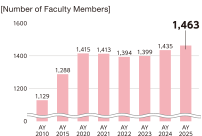
During the R2020 period from AY 2011 to AY 2020, Ritsumeikan University pursued planned improvements to education and research conditions, with the enhancement of educational quality and the learning environment as its basic objective. Specifically, the University has worked to improve the learning environment for each student by enhancing its educational framework through a steady increase in the number of full-time faculty members, developing and renewing campuses and education/research facilities, and expanding scholarship and learning support systems. A major feature of this period was that the University promoted learner-centered education and globalization without revising standard tuition.
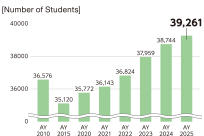
At the same time, the University faced a series of external changes that were difficult to address on its own, including a decline in student numbers due to stricter enrollment-capacity management, an increase in the consumption tax rate, and higher social insurance costs. In addition, in AY 2020, as the COVID-19 pandemic intensified, an urgent need arose to take measures to sustain students’ learning and daily lives. Drawing on the financial base it had built up to that point, Ritsumeikan University was able to act quickly to continue its educational activities even during an emergency. However, as these multiple factors converged, the operating balance for educational activities turned negative in AY 2020. Through this experience, the need for stable financial management from a long-term perspective was once again strongly recognized.
(2) Initiatives and Achievements in the First Half of R2030
During the first half of R2030, from AY 2021 to AY 2025, Ritsumeikan University worked under the R2030 Challenge Design, based on its recognition of issues from the R2020 period, with the basic policy of advancing ambitious education and research measures for the future while also strengthening its financial base. Aiming to develop into a next-generation research university, the University has continued to implement initiatives, including giving concrete form to the Ritsumeikan Advanced Research Academy (RARA) Initiative, which promotes priority research, and the Grassroots Practice Support System, which supports faculty and staff in voluntarily engaging in co-creation across job categories and organizational boundaries. These measures have been implemented so as not to increase reliance on tuition and fees, using budgets funded by interest and dividends rather than student fees.
In addition, during the first half of R2030, the University participated in Expo 2025 Osaka, Kansai, Japan and held events such as the Kinugasa Art Village Festival, BKC Welcome Day—Biwako-Kusatsu Well-being Festival, and Ibaritsu (Ibaraki × Ritsumeikan DAY), as part of initiatives to broaden its relationships with society and local communities. These initiatives create opportunities for students to deepen their learning through exchanges with local residents, local governments, and other stakeholders, while also providing opportunities to communicate the University’s education and research activities and student initiatives to society. These practices can be positioned as one important achievement in the first half of R2030, as initiatives that promote mutual understanding between the University and local communities and society, and strengthen partnerships based on relationships of trust.
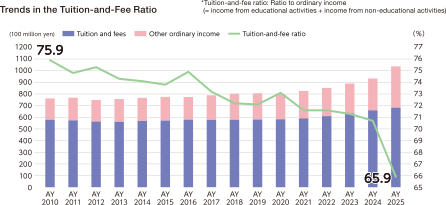
In addition, to improve the underlying operating balance, the Executive Board of Trustees, after multiple rounds of rigorous discussion, proposed a tuition revision method that incorporates the Academic Maintenance and Improvement Fee, intended to sustainably maintain and improve education and research conditions. Under this method, the recovery in student numbers and the increase in revenue from tuition and fees resulting from the tuition revision have played an important role in improving the soundness of the University’s financial and operating balance. In addition, by stabilizing interest and dividend income through stronger asset management, strengthening donation policies, and securing large-scale external research funding such as the Program for Forming Japan’s Peak Research Universities (J-PEAKS) and the Space Strategy Fund (SX), which serve as benchmarks for becoming a next-generation research university, the University has been gradually building a foundation for sustainable academic and financial management while curbing excessive reliance on student fees.
On the expenditure side, amid continued strong upward pressure from factors such as improvements in compensation for faculty and staff, inflation and rising raw material costs, the weakening yen, and measures taken toward an increasingly sophisticated IT environment, the University is also working to reduce costs by reviewing operations and promoting DX.
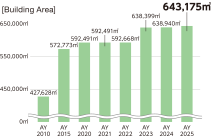
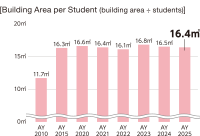
Changes in Campus Area per Student
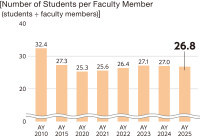
Trends in the Number of Students per Faculty Member
Trends in the Tuition-and-Fee Ratio
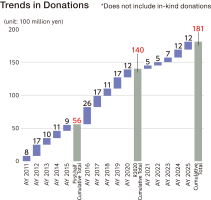
Trends in Donations
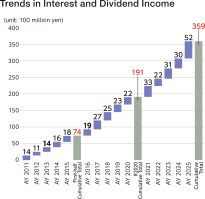
Trends in Interest and Dividend Income
Expense reduction initiatives: Accumulation of cost reduction efforts over time amid strong spending pressures due to changes in social conditions, etc.
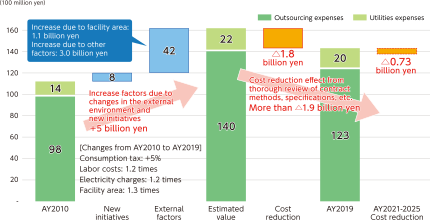
Since AY2020 as well, the University has continued expense reduction initiatives by discussing labor-saving and automation measures using DX and other means, and by reviewing operations themselves.
AY2021: △270 million yen / AY2022: △60 million yen / AY2023: △50 million yen / AY2024: △150 million yen / AY2025: △200 million yen
(1) Trends in outsourcing expenses and utilities expenses, which are the main targets of cost reduction.
Figures for AY2010 and AY2019 are actual results.
(2)Labor costs are based on the minimum wage (national weighted average) (https://jbrc.recruit.co.jp/data/data20250912_3929.html).
(3)Electricity charges are based on the average unit price for industrial use (https://www.enecho.meti.go.jp/about/pamphlet/energy2025/03.html#section2).
Contents
-
Chapter Ⅰ
Significance and Positioning of the AY 2026 Plenary Council
To consider the future direction of Ritsumeikan University
- 1. Changes in the social and higher education environment surrounding universities
- 2. What changes in the social and university environment have asked about undergraduate and graduate student learning
- 3. The types of undergraduate and graduate students Ritsumeikan seeks to produce in light of changes in the social and university environment
- 4. As we enter the second half of R2030
- 5. The Role of the AY 2026 Plenary Council
- 6. List of key themes and annual schedule for AY 2026
-
Chapter ⅡThe Plenary Council as a Process of Academy Co-creation
—Building on Discussions Since AY 2022—
- 1. Progress Made in Academy Co-creation and the Expanding Dialogue
- 2. Division of Roles and Coordination Between the Plenary Council and Plenary Council Representatives’ Meeting
- 3. Specific Examples of Advancements in Academy Co-creation
- 4. Less Visible Issues and the Expected Role of Five-Party Discussion Meetings
- 5. Context Leading Up the AY 2026 Plenary Council
-
Chapter ⅢRitsumeikan University’s Initiatives from AY 2022 to AY 2025
—Progress in the First Half of R2030 Toward Enriching Education, Research, and Student Life—
- 1. Development of the Learning Environment and Academic Reform
- 2. Advancing Research and Supporting Graduate Students and Early-Career Researchers
- 3. Expansion of International Learning and Multicultural Collaborative Learning
- 4. Enhancing Student Support Services to Support Student Life and Extracurricular Activities
- 5. Career Development Support to Foster Independent Career Choices
- 6. Developing the Infrastructure to Support the Visualization of Learning and Growth
-
7. Campus Development and Initiatives to Support Education, Research, and Student Life
- (1) Campus Development Centered on Social Co-creation (OIC)
- (2) Initiatives Linking the Humanities and Social Sciences with Creativity (Kinugasa)
- (3) Initiatives Supporting Cutting-Edge Research and Science and Engineering Education (BKC)
- (4) Development of a Common Infrastructure to Support Student Life
-
Chapter ⅣKey Educational, Research, and Student Life Initiatives for the Second Half of R2030
Building on Dialogue with Undergraduate and Graduate Students to Enrich the Present While Envisioning Future Developments
-
1. Directions for Academic Reform in the Second Half of R2030
- (1) Articulating Integrated Education and Connecting Inquiry to Research
- (2) Reform of University-Wide Education and the Development of Learning that Connects with Society
- (3) Internationalization of Education and the Development of Multicultural Collaborative Learning
- (4) Educational DX and the Visualization of Learning
- 2. Enhancing Graduate Education, the Research Environment, and Career Support
- 3. Creating an Environment That Supports Student Life, Extracurricular Activities, and International Learning
- 4. Connecting Experiences to Meaning-Making and Career Development
-
1. Directions for Academic Reform in the Second Half of R2030
-
Chapter ⅤFinancial Management during the R2030 Period and Ritsumeikan University’s Student Fees and Finance Policy for AY 2027 and Beyond
- 1. Financial Structure of Private Universities and Ritsumeikan University’s Basic Approach
- 2. Financial Management from R2020 Through the First Half of R2030 and Achievements to Date
- 3. Financial Management in the Second Half of R2030
- 4. Student-Fee Policy for AY 2027 and Beyond and AY 2027 Tuition and Other Fees
- ConclusionToward the open session of the Plenary Council to Be Held in October 2026